
There’s a thing people can’t stop saying on the internet. It’s an extremely boring thing, but people keep saying it: “I am thrilled,” it begins, “that Amazon has been recognised as a Top Employer in the UK…” and then they talk about “unwavering commitment” and “Earth’s best employer”. I’ve found these sentences, word for word, on the websites of 16 different local newspapers, attributed to 16 different people. None of the journalists who supposedly interviewed these people has responded to my requests for a chat about this strange zombie quote. I don’t blame them, and I don’t think they’re lazy. Local papers, having been defunded by social media, can’t spare a reporter to conduct interviews for every article, and even if they could, it looks as if Amazon would prefer to avoid its employees using their own words. The job of speaking and the job of listening have been changed by technology and the need to do things at scale. They have been deprofessionalised.
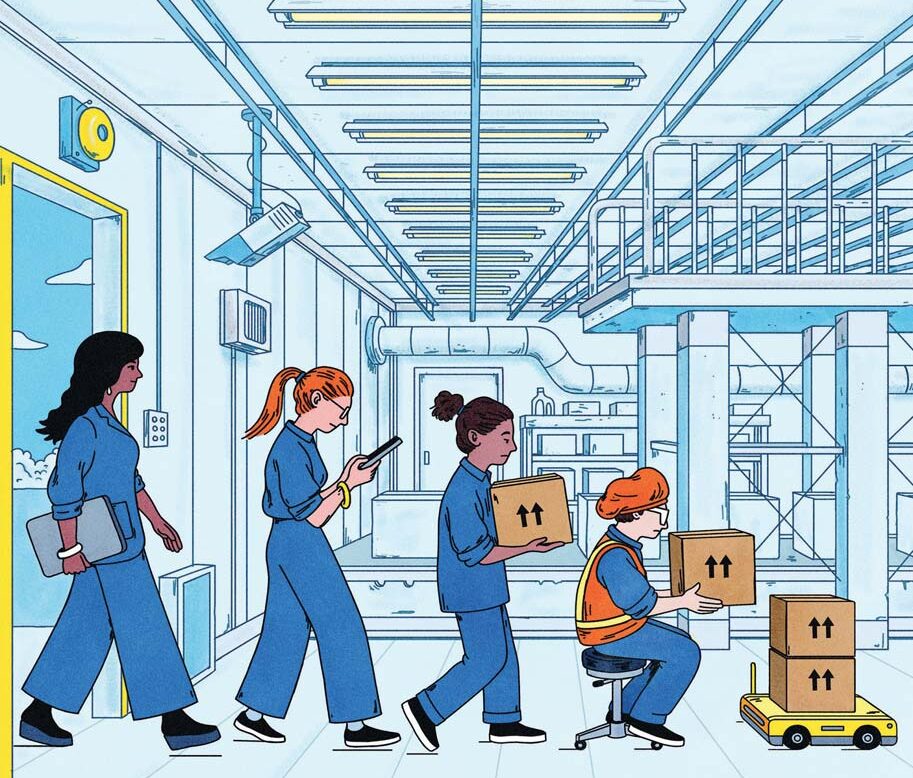
The same is true inside the Amazon warehouse, where the people working for Earth’s Best Employer have found that even in a low-paid warehouse job, it is possible for skill and agency to be taken away. A ten-hour shift in the company’s giant distribution centres once involved walking as much as ten miles, as workers roamed the shelves for products, scanning them by hand. In the newer, robotic warehouses, they now stand still; the shelves themselves are brought to them by robots. The scanning is done by cameras and AI systems; unseen workers in other countries support these systems, watching thousands of products per day being placed on shelves. In the warehouse, the job is reduced to simply picking up objects, as directed by a screen, and placing them in different boxes – because there is no robo-hand that can do that job as well, for as long, for the right amount of money. Yet.
As Sarah O’Connor reports in We Are Not Machines, there are two sides to this change. On the one hand, as an Amazon manager explains, the workers no longer have to walk for hour after hour on aching feet. But that robots have taken on some of the work has not made their job any less robotic; it has made it more so. The physical problem-solving of the manual warehouse has been eliminated, replaced by work that is “faster, lonelier, and more monotonous”. Some workers delete the clock display from their screens so they don’t have to watch the minutes inching past.
For the engineer Frederick Taylor, skilled work was a problem to be solved. In his Principles of Scientific Management, first published in 1911, Taylor wrote that factory managers were confronted by the fact that “their own knowledge and personal skill falls far short of the combined knowledge and dexterity of all the workmen under them”. The managerial class was therefore reduced to simply asking workers to do their best for the company. The workers, whom Taylor believed were naturally opposed to such effort, were bound to refuse (unless they were paid more, which he was also keen to avoid). His solution was to design workflows that removed what he called – in quotation marks that betray his scorn for the word – “initiative”. The skill of an individual worker could be broken up into lots of little pieces and reassembled, expunged of individual agency, in favour of capital.

Taylor’s ideas spread into factories around the world; Henry Ford and Vladimir Lenin were both exponents of increasing productivity by removing independence of thought and action. When it eventually became impossible to wring any more efficiency out of factory workers in developed economies, the factories themselves were moved to countries with lower wages and fewer rights. In general, Taylor’s principle has held: the less agency labour has, the higher the returns to capital. In the mid-20th century it began to be introduced to white-collar work, as law and accountancy adopted the principle of the billable hour.
O’Connor’s reporting shows that this principle has taken on a new significance with the arrival of AI models. These too work on a Taylorish principle, using the work that humans have previously done to “train” a machine to produce the same results, without thought or intention intruding on the efficiency of the process. As in the Amazon warehouse, this doesn’t necessarily make the jobs of the people who are expected to work with these tools easier. Professional translators were among the first to feel the change: work dried up, and the work that remained was not the subtle and fulfilling practice of passing meaning from one language to another; it was a more mechanistic process of rapidly checking through translation that had been done by a machine. They found it stressful, less rewarding and less human. Silicon Valley’s promise had been that AI would take over the boring parts of people’s jobs, leaving them free to work more creatively, but the translators found the opposite to be true. And they have a warning for the rest of us: one translator tells O’Connor her profession is “the canary in the coal mine”.
For young workers hoping to enter the job market, the sense of an automated future is compounded by the fact that their job interviews are often with a computer rather than a human being. Online “hiring platforms” require applicants to answer questions on camera, giving responses that are assessed by a “conversational AI”. This allows employers to “interview” thousands of applicants easily, but it also changes the recruitment process in favour of those who can game the system – those who can work more like a robot. Employers say they have to use these systems because they are deluged with so many applications (most of them written by chatbots) that no human could go through them all. And so the work of applying for a job, and of finding the right person for a job, has been deprofessionalised by technology: the employer is swamped with slop applications and the applicants are subjected to a dehumanised process, in which it seems the company they want to work for can’t be bothered to give them even a moment of human attention.
This is not, however, a simple story of life getting worse for workers in an increasingly automated future. In her perceptive and captivating reporting on the rapidly changing world of work, O’Connor also finds people whose jobs are improving as a result of technological change, and others whose work is becoming more human. In social care, so often characterised as a sector that simply needs to be fed more money and more workers, she finds that better results are possible by giving workers more autonomy. (Silicon Valley’s preference, of course, is for us all to be looked after by robots.)
This is a principle that has been established on the British high street. In the 2010s, James Daunt took over the ailing Waterstones chain of bookshops and gave store managers the power to decide which books they stocked, breathing new life into the company.
But these are exceptions: the trends established by Taylor and Ford continue to radiate out into workplaces across the world. Capitalism, that self-sharpening blade, cuts always in favour of the manager and the owner. If we want the world of work to become more human, she writes, we will have to be prepared to take a stand.
We Are Not Machines
Sarah O’Connor
Allen Lane, 256pp, £20
Purchasing a book may earn the NS a commission from Bookshop.org, who support independent bookshops
[Further reading: What did the Black Death ever do for us?]
Content from our partners

Related



This article appears in the 17 Jun 2026 issue of the New Statesman, The Race
Join the debate
Subscribe here to comment